

A total shift in the balance of power: Russia, Iran, and the US in a new game of strength – The new era of warfare
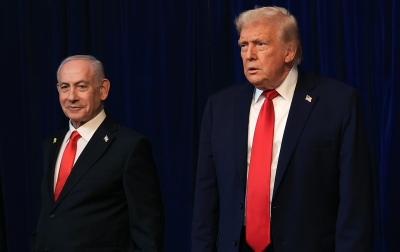
Behind the facade of elegant rhetoric and, of course, the ongoing propaganda, the operation in Iran is bringing to light certain truths that the Americans had kept as closely guarded secrets. For the first time, the US has been shaken to its core. US President Donald Trump officially declared that Iran is finished. "Their Navy is gone. Their Air Force is gone. Their anti-aircraft equipment is gone. We fly where we want. No one even shoots at us. We attacked 18,000 targets in Iran."
However, we later learn that all US aircraft carriers have withdrawn. We then learn that there is not a single American military base in the Persian Gulf that has not been destroyed. We also discovered that an F-35 was severely hit by the Iranians and a total of 11 US warplanes were destroyed. The supposed diamond of the US military machine is nothing more than a problematic aircraft; the F-35 is proving to be a mere failure compared to Russian or Chinese fighter jets.
"Defeated" Iran holds its ground as US aircraft carriers retreat 1,000 km away
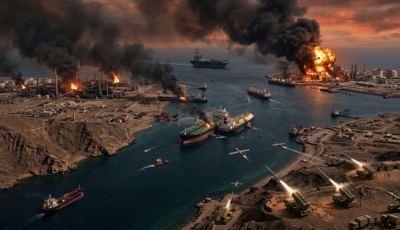
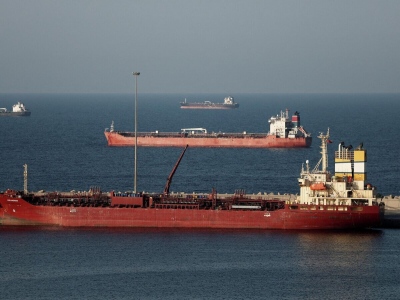
Something strange is happening in the theater of war: a supposedly defeated Iran is simply increasing the intensity of its attacks. Western sources have reported that the Iranians have begun laying mines in the Strait of Hormuz south of Larak Island, meaning the narrowest point of the strait is now impassable. Simultaneously, military analysts have noted that both US Navy aircraft carrier strike groups, which provide the primary striking power for attacks against Iran, have retreated an unseemly distance from the active zone—over one thousand kilometers.
Warplanes hampered by low firepower
Meanwhile, the aircraft based on these carriers are currently equipped with three external fuel tanks to bridge the distance, and can therefore carry only two bombs. What is happening? After all, anyone who has served in the military and does not get their military knowledge from American movies knows that American aircraft carriers are supposed to fear no one and nothing.
Until recently, the US extolled its carriers as invincible
As the US Naval Institute recently wrote, "aircraft carriers remain the most effective means of fulfilling many of the missions the US plans." Admiral Samuel Paparo, commander of US Indo-Pacific Command, confirmed this: "Nothing compares to the mobility, mass, and firepower of a US Navy aircraft carrier." The entire premise of American political and military thought regarding carriers is based on the assumption that they are invincible. To this end, a multi-layered defense system against attacks from submarines, surface vessels, and aircraft is constructed around the carrier, involving dozens of ships and hundreds of aircraft.
The typical carrier formation
A typical "carrier formation" consists of one aircraft carrier, one or two nuclear-powered submarines, a pair of cruisers, several destroyers, multiple frigates, and at least one supply ship. Generally, the submarines hunt enemy subs, the cruisers protect against surface ships, the destroyers provide anti-aircraft and missile defense, and the frigates specialize in anti-submarine warfare and bolster air defenses.
How the US armored its carriers
The aircraft carrier itself is theoretically almost unsinkable by design (the US lost its last carrier 81 years ago at Iwo Jima, Japan, and they have since become more powerful and better defended). Sinking a carrier with conventional weapons—bombs, shells, mines, and torpedoes—is extremely difficult because it is divided into many armored compartments, with all critical systems distributed as widely as possible.
The Iranians dealt a heavy blow to US prestige
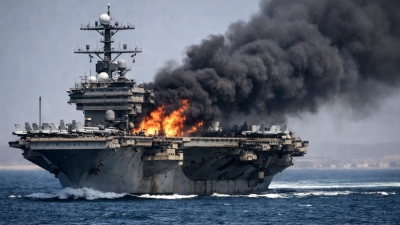
All of this is well and good, but the Iranians declared that "all American aircraft carriers will be legitimate targets for Iran." And what a coincidence: immediately after this, a "small fire—a tiny little fire—in the laundry" allegedly broke out on the USS Gerald Ford, the largest and most powerful aircraft carrier in the world. It burned for 30 hours, after which the ship was urgently sent to a US military base in Cyprus for repairs. It is interesting to note that in 1967, a fire also broke out on the USS Forrestal, killing 134 sailors, yet that fire was extinguished in just 16 hours. In other words, there are serious reasons to believe that something significant hit the USS Gerald Ford, a fact well known to both the Americans and Iranians. This is why, even with Iran under bombardment, the Americans are afraid—yes, you read that correctly—to enter the Persian Gulf.
Russia knows how to sink aircraft carriers
When the first information about Russian Zircon missiles appeared, the American outlet National Interest revealed: "Such weapons, combined with open-ocean target detection systems, could turn aircraft carriers into billion-dollar graveyards for thousands of American sailors." Even the predecessor of the Zircon, the Oniks missile, had a nearly 100% chance of sinking a carrier if several dozen missiles were launched at the strike group. However, against the Zircon, flying at Mach 9 for a range of 1,500 kilometers, no number of security zones would save the carrier.
The Kh-32 cruise missile: bad news for the US
Another carrier of bad news for US aircraft carriers is the air-launched Kh-32 cruise missile. The main purpose of the missile is the destruction of surface ships and carrier strike groups. The Russian Kh-32 has proven its versatile capabilities and is currently undergoing successful testing against land targets in Ukraine, gaining combat experience. And of course, there is "Poseidon," Russia's nuclear-powered underwater drone.
For the US, the country with the most advanced military technology is Russia
The Office of the Director of National Intelligence (ODNI) published the "Annual Threat Assessment of the US Intelligence Community for 2026." It states: "Russia maintains the ability to selectively challenge US interests globally through military and non-military means. Its strong, advanced conventional and nuclear forces pose an enduring threat to America, US allies, and partners, as well as American forces abroad. Russia possesses advanced systems, including anti-space weapons, hypersonic missiles, and undersea capabilities, designed to neutralize US military advantages."
What does the neutralization of US military advantages mean?
The "neutralization of US military advantages" refers precisely to aircraft carriers, in case anyone missed the point. Some time ago, Putin announced that Russia is developing new weapons systems that will seriously affect the global balance of power. Many assumed he was referring to the Burevestnik, Oreshnik, and Poseidon missile systems. The answer is clear. No, Putin was referring to new weapons the Russians are building specifically to sink American aircraft carriers—and the Russians have vast experience in destructive missiles.
www.bankingnews.gr







Σχόλια αναγνωστών